
a portrait of my recession:
as reenacted through the history of the American typewriter
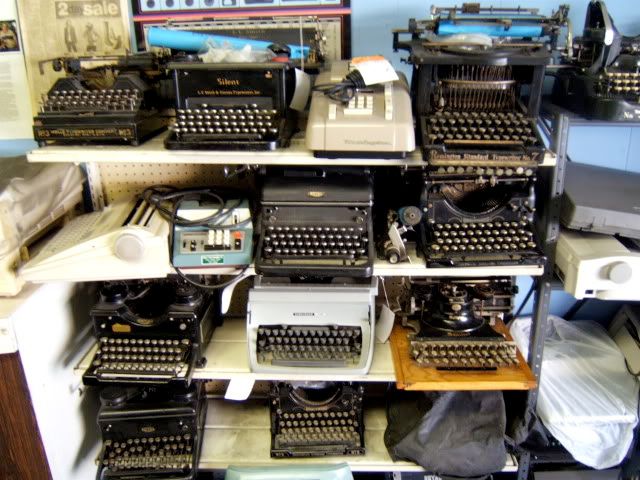
Since I have been unemployed, I have been trying to stay busy in other ways. I have been reading a lot, playing and recording music (again), but I also have been writing a lot more. Over the last couple of years I have kept a written journal that I carry with me almost everywhere. I have nearly filled all of the pages in it, so I decided that it was time to get a new journal. Instead, I have been writing in a couple of small Moleskin notebooks I picked up while I was in Amsterdam. Although these have been great for noting little ideas and thoughts while I'm on the train or elsewhere, it was not quite the replacement I had wanting to use for writing longer passages.
I have been using my computer as my main mode of thought processing since I've owned it. Although it is a perfectly fine machine, I have had a couple of bad encounters with saving important documents electronically. A couple of years ago, my computer completely crashed leaving me with what I thought was a dead hard drive. I took my computer to the Genius Bar, where miraculously, most of my documents, photos and music were salvaged. I then promised to never let this happen again so I backed everything up on my external drive. A few weeks ago, I wanted to go back and review some of my papers and other writings from my college days so I plugged in my external drive and went through the index of various electronic documents. Although my photos and music are all on my drive, for some reason I could not access my written documents! And to think, I have almost everything I have ever created saved on this single hard drive is a bit frightening. I went to the Apple store yet again with a second hard drive issue and this time the diagnosis was not curable. I had lost all of my little thoughts, written dreams, research papers, etc. Five years worth of expression - poof. Needless to say I was pretty crushed at never being able to view these things again as I had years of my personal, academic and professional writings saved up on this stupid thing. I kept a journal on my computer while I was in Alaska, and it is now all gone. Very sad.
This frustration led me to a disbelief in the computer's hard drive as a secure place for very valuable items. Although I have dozens of "photo albums" saved up on my computer and elsewhere (facebook, photobucket, etc) I had nowhere else that I was keeping my documents. I remembered that we had an old IBM Selectric III typewriter at my parents house and thought about using the typewriter instead of a computer as a tool for my creative writing. It turns out that my dad had donated the typewriter to Salvation Army just weeks before I asked for it. I actually remember banging around on it as a little kid. It was heavy, brown, boring looking but very well made.
I had remembered seeing typewriters at the various thrift stores I go to and decided that I should check them out again to see if I could find something. I remember one time last summer going to The Ark thrift store on Lincoln Ave and seeing several typewriters at any given time. So that was the first place I checked. There I found a couple of earlier Smith-Corona electric models that were pretty well beat up and busted and also saw a newer Smith-Corona electric model which I did purchase for $10. It is a Smith-Corona XL 1800 which to me is completely indistinguishable from all of the other XL and SE models they produced in the 80's and early 90's. Having gone to half a dozen resale shops and thrift stores since I have seen a model like mine everytime. Because these models are so common, it is easy to snag the ink "ribbon" from them. I now have a supply of ink cartridges for this typewriter to last me quite a while. Also, what makes these models fairly unique is that the script wheels (or daisy wheels) are easily interchangable. For instance, you can go from a standard courier print to a cursive print by changing out this plastic print wheel - and it take just a few seconds to do.

I used this typewriter every night for the first couple of weeks I owned it. Mine was pretty much in mint condition and looked like it had barely ever been used. One night when using it, the machine began to spasm uncontrollably. So I unplugged it and plugged it back in. Still, it didn't know what to do. In a fit of frustration I began banging on the casing and mashing buttons hoping that it would somehow jolt the life back into the dying typewriter. Oh the humanity! Eventually, the machine returned to normal but I had completely forgotten what I was going to even write. This little incident further led to my frustration with electronic-mechanical devices. I then decided that a manual typewriter would be the end-all to my desires for a stable and reliable tool for documentation.
I remembered seeing a couple of older Remingtons at the Village Discount over on Milwaukee Ave. but decided to pass on them at first. One was very clean looking but non-functioning and the other was a bit rusty and beat up but did function properly. After checking a few other stores with no luck I decided I'd go back for the one typewriter that did work. When I went back just a day or two later both machines were gone.
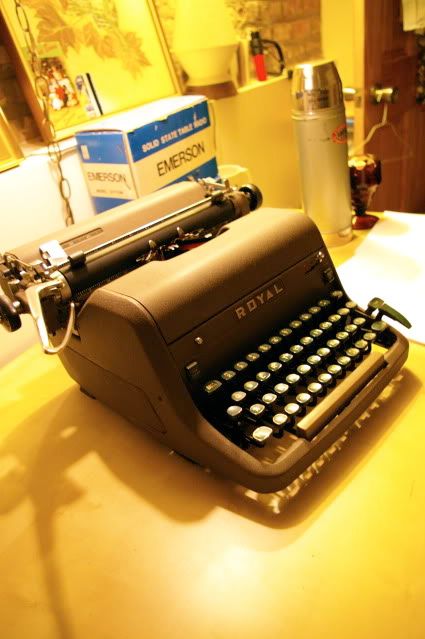
A couple of weeks ago I bought my first manual typewriter at the Logan Square Salvation Army on Fullerton Ave for $10. It is a cold war era Royal HH model. At first, it did not appear to work. After fiddling around with it for a few minutes, I was able to get it to work. So I decided to buy it and I carried the ~15-20 pound typewriter home with me. When I did get home, I gave it a cleaning and lubricated as much of the moving pieces as I could reach. After this, the typewriter worked beautifully. I like it for its almost symbolic purposes. Although it looks rather boring and bland, it is built extremely solid. It is very representative of American industry at the time as it was clearly made to last a long time.
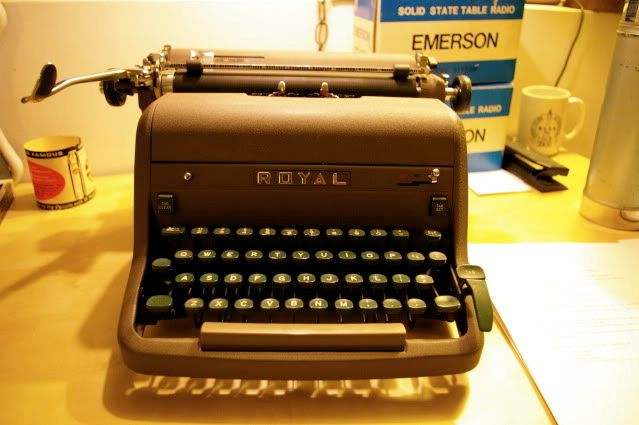
Writing on it takes a little bit more work than the other typewriters I've used, as it seems you almost need to mash the keys to get it to print. I did some research and this seems to be one of the first models Royal produced after the war. Civilians were not allowed to purchase typewriters during the war as restrictions on raw materials were very tight at the time. So, nearly all of the typewriters made during the 1940's were for military use only. This model is one of the first mass produced, consumer oriented post war models and it certainly has that no-nonsense, tough cold war 1950's feel to it. It features Royal's "Magic Margin" function which I found confusing at first. Eventually, I got the hang of it and I began typing away with ease.
After buying this first Royal, I began doing all kinds of research on manual typewriters and started reading up on the various makes, models, history and mechanics of the machine. Although I do enjoy the big Royal, I decided that I also wanted a portable manual that I could take with me if I decided to go anywhere for the holidays. I kept my eyes peeled on craigslist and also at the local thrift stores. I had also just sold a very valuable guitar that I used when I was playing professionally and decided that I would get a really nice portable - perhaps something collectable. I had seen and appreciated the design of the Olivetti Valentine and thought it was really cool, however I wasn't ready to throw down the $300 that they have been selling for on eBay. So one day I made a visit to Ravenswood Antique Mart as I had heard they had a couple of really nice typewriters there. I had my heart set on an orange typewriter since I wanted it to go along with the theme I've got going on in my room. And while I was there I saw the one I really wanted - an orange Smith-Corona Super G. The only thing was that their asking price was $350. I thought that this was the most absurd thing I have seen and clearly decided to pass on it. I found that this particular "antique mart" was more of a glorified resale shop aimed at selling Mid-Century Modern furniture and items to the people living in the neighborhood who generally had disposible income. I strongly prefer to buy locally, and searched around quite a bit but gave in and decided that I would go the internet route for this particular model since it was a bit more rare. So I started watching a few of the same typewriters online and thought I would pick one up. They were selling in a range from $40 to $100 and some where even going for more. I kept getting outbidded or would back down when they started getting a little too pricey. So then one day, a Super G popped up on eBay without pictures attached to the listing. Generally, this is sketchy as an online auction without pictures can be a bad bet. However, I contacted the seller and asked if he could email me pictures and he did. I was the only one to bid and I got it for $20. The seller was an older man who didn't know how to navigate online resale. This is a theme that continued to reappear and my attitude towards impersonal online purchases began to change throughout this time.
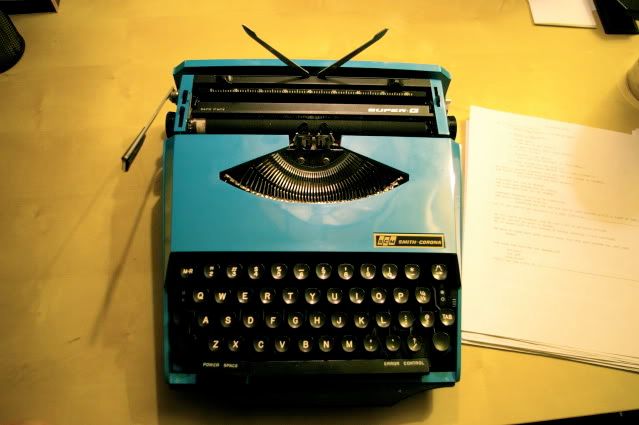
This typewriter is very light and easy to carry around as it is mostly plastic. Generally, most people don't think very highly on the 70's era plastic typewriters but I thought I'd give one a shot. There is definitely a noticeable difference between the Super G and the Royal. Although this one is much easier to write on, it does feel kind of flimsy and not as solid while writing. But there's a reason why there are so many different models of typewriters. It's kind of like a bicycle, no single machine can do it all. I used this typewriter a few times and then put it away. The print is a bit bigger than the Royal and a little more "bubbly" I guess. I feel like this typewriter was Smith-Corona's shot at making a stab at the Valentine. The Olivettis were Italian designed and made in Spain. This is an Italian designed but made in Great Britain typewriter from an American company. Smith Corona hired the Ghia design firm who also created the famed Volkswagen Karmen Ghia. The case to this typewriter hints at the firm's heritage in auto design as it has racing stripes down the front. Although the design is cool, its function is the same as almost every other Smith-Corona of its day. This particular model almost represents an identity crisis of the typewriter industry in the 70's. It seems that you had to make the machine really fun to look at for people to be excited about writing.
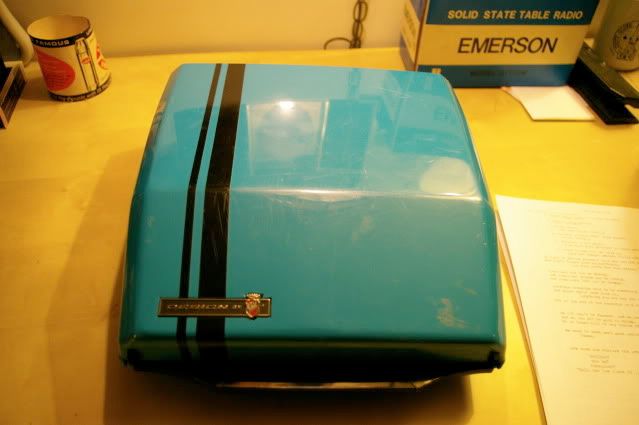
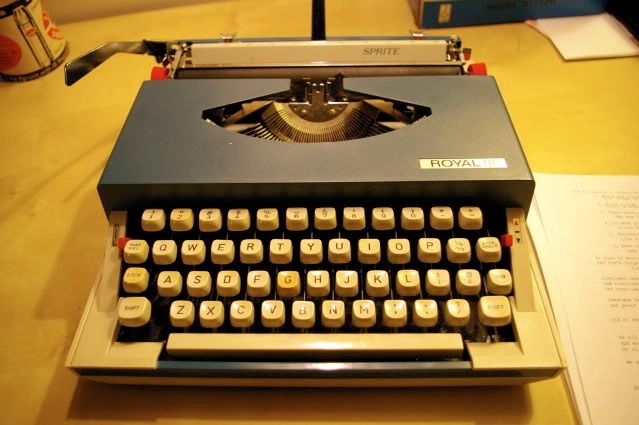
Alright, so my little recession/unemployment hobby was turning into a bit of a consuming obsession. At this point I had spent more time learning about all of the different aspects of the typewriter than actually writing. That's not good. I liked all the typewriters I had acquired, but I still felt that none of them fit that happy medium I was looking for. I just wanted something fairly light weight and portable, but also wanted it to feel sturdy enough and solid while writing. I also wanted something that I wouldn't worry about if I scratched it or even broke it. I had done some research and found that most "writers" almost unanimously swear by the Olympia SM series. So I was doing a local zip code search and found one in the city and watched it for a few days. It got away from me at the last minute. However, shortly after, I found a portable plastic 70's typewriter, the Royal Sprite (which is only a Royal in name) that was also in the city and contacted the seller about it. The starting bid was $10 so I figured it was at least that much and I would just see what happened. I didn't watch it for a couple of days thinking that I would have been outbidded. However, low and behold I was the winner at a whopping $10. When I got it, I was happy to find that everything worked fine and it even had a fairly new ribbon in it. So I started plugging away on it and it felt surprisingly solid. Although it isn't necessarily a "real" Royal per se, it seemed to fit every criteria I had. I also think it looks pretty cool too for how cheesy and cheap it is.
Ok, so now I had acquired quite a few typewriters - the ones I have mentioned and then a couple of other electric models that I bought at thrift stores for $5 each (including one I gave to my roommate as a gift). The electric typewriters use almost a cartridge style nylon tape spool as where the manuals use an older fashioned nylon ribbon that connects two seperate round spools. The big Royal's print was starting to fade pretty quickly and so I decided that I should focus more on getting these things in better working condition instead of attaining more typewriters. After doing a quick search on eBay, I saw that you can purchase a ribbon for $9 (including shipping). Before buying these, I thought I'd search to see if anybody was still selling typewriter supplies locally. I would not really have expected to see anyone selling typewriter supplies much less typewriters themselves! After the first minute of searching I came across Independence Business Machines up north in Ravenswood. I called the shop and asked if they had the right ribbons I was looking for, the man on the other line assured me that he did and said that they were $15 each. I decided that I'd much rather just spend the extra $5 and support a local business, especially one that represents a dying industry. I remember reading an article about how the digital camera has nearly caused the complete demise of the old film photo shops just like how the word processor has made the typewriter and the industry that surrounds it obsolete. I checked out the website, and was excited to see that the owner, Mr. Kazmier seems to have enough work repairing and restoring these "antiques". There's actually a pretty cool video of the store and of Mr. Kazmier out there. It seems that the typewriter store attracts a particular person. So I made it to the shop today to pay Mr. Kazmier a visit.
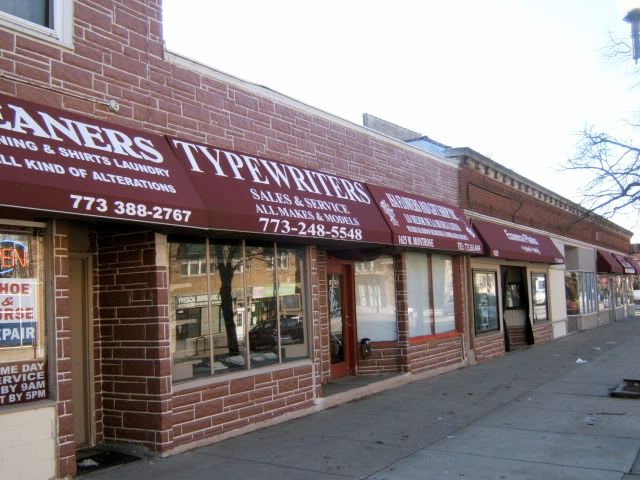
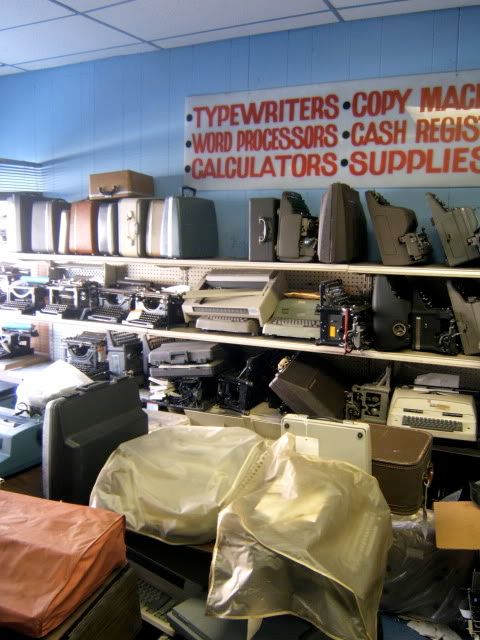
When I first stepped inside, Mr. Kazmier was working on an adding machine. He didn't even look up to see me there. So I approached him and nodded and he told me to give him a couple of minutes so he could finish what he was doing. The store was filled with old typewriters and parts. Most of them were customer repairs and restorations but he did have a few for sale in a display by the front window. He had typewriters from all eras in there for repair but was only selling classic portable manuals.
 Mr. Kazmier is an older man and told me that he has been doing this kind of work for decades. He finally finished up with the calculator and as he did, the customer who owned it had just come back. I stepped away so that he could get settled with this customer. A short dialogue went back and forth between the two. Mr. Kazmier had shown the man that the adding machine again functions properly and prints. It needed a new ink ribbon, and he had went ahead and installed it for the customer. The charge for $20 for the ribbon, the install, and fixing the printing mechanism. The customer was unhappy at the price and mentioned that he could buy another one at a thrift store for $20. Mr. Kazmier became upset at this argument and showed the man that he had made the machine work perfectly again as where one from a thrift store may not function as good or at all. The customer looked at it and said that he only wanted to pay $10, then quickly said that all he had was $10.
 Mr. Kazmier quickly retorted, "I fixed your machine for you! If you didn't want me to, why would you bring it in and ask me to fix it? Why do you think I'm here? I'm not here for my health!" The customer said that the calculator was city property, and then Kazmier replied back, "If that's the case I should charge triple the amount then!". Finally, the customer pulled out a small wad of cash and said that it was ten dollars. Totally frustrated and offended Kazmier said, "For you - no charge! Don't insult me, keep your money and get out of my store!"
After the customer left, I was unsure whether or not my presence during the fiasco had been a bother to him or not. I looked at him and he looked back and said, "You know, people bring in these old machines and think that I will fix them for free!" I said that I had no intentions of hassling him and that all I came for was a couple of ribbons. He seemed relieved that I had such a simple request. I had brought my portable Royal with me so he could see it. He had the correct replacement and installed it right there in less than a minute.
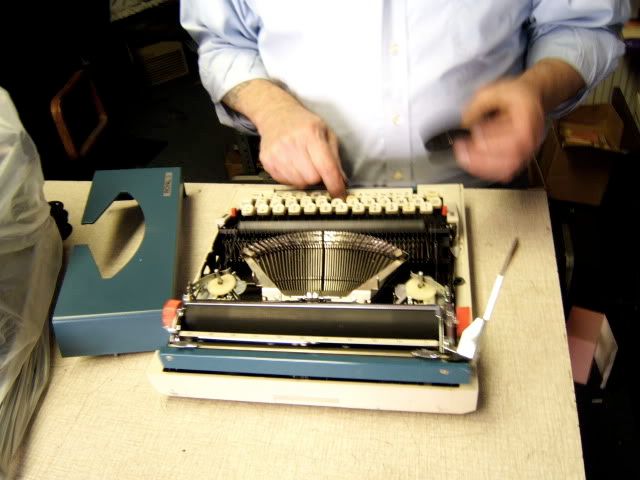
I've certainly gone through a lot of motions throughout this whole job search process. I certainly realize that these are not the easiest of times to be a small business owner - especially of a business that is based off of a dying platform. And I have definitely become quite familiar with rejection over this last year with job searches, family ordeals and other relationships. And for some reason I feel like this simple ink ribbon may be the cure for setting me at ease in these tough times. As Mr. Kazmier installed my ribbon, he was still upset at the last encounter. He was saying something to the affect of, "I work on typewriters. Nobody makes them anymore. Everyone else was smart and got out of this business and started selling computers." There was once a time where American industry set the standard throughout the world in terms of quanity produced and build quality. Mr. Kazmier is proud of this heritage and clearly holds on to the notion that there was once a time where someone could make a respectable living doing this work. I even have witnessed a similar effect but in the bicycle world. All people want anymore is cheap, disposable items - and it's gotten to be very wasteful. We also had people bringing in old busted up bicycles and expected us to fix everything for free. There was once a time where you had to save up to buy something, and when it broke you either fixed it yourself or took it to a repairman. I have always admired the idea of being a small business owner, but because of how competitive retail and resale has gotten, it almost seems impossible. Today, big business is bigger than ever and consumers have to actively seek out the small man to keep the neighborhood business alive. It is difficult to compete against ebay, online retailers and big box stores that can under cut any mom and pop shop. I had brought up this notion to Mr. Kazmier. I told him that I had no idea that there was a typewriter shop in Chicago until a friend had told me and that I was ready to purchase these obsolete parts online only because it seemed as though there were no other route. Mr. Kazmier had mentioned that people bring in ribbons that they've boughten off of ebay and generally the quality is quite poor. "They buy these ribbons off of ebay and find that they're already dried out! They don't work. I sell good ribbons and I get a shipment in every couple of weeks". He dug up the other ribbon for me and I gave him the $30 I owed and said thank you. I was glad to have made this trip.
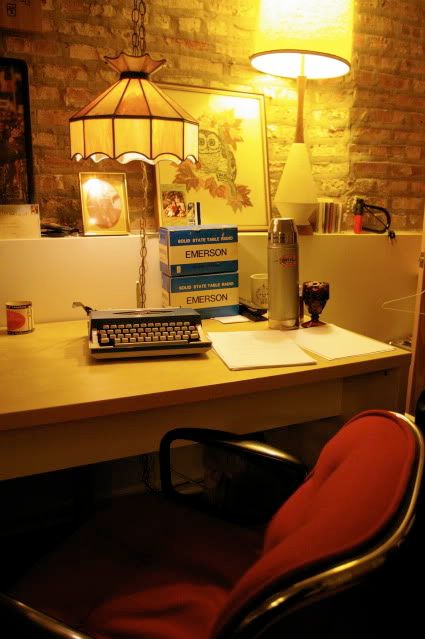
So now I am at home, wondering what this machine will pull out of me. I wonder why I've become so disillusioned with the way things are today, why I keep finding myself attracted to those who are working against the tides of superficial change and who hold on to the reliable things from the past. I call people and knock on doors to talk about politics. No one really seems interested. They seem to be more interested in television shows than talking about what issues concern them and what they would like to see fixed. And then I think about who I will become ultimately. Ideology is cheap these days. You can buy any kind of street cred or affiliation you want. Community is an abstraction and this economic recession is only a visible by product of our cultural recession. And so I've built a room for myself in the basement to sit in and think and to read about the things that all the great people in the world have done. And I don't think about what I'm missing out on anymore. I've finally become content again with letting the universe work its mysterious ways. Everyday I wake up with the attitude that I cannot predict what will happen, and if I just keep my eyes and ears open, I generally see something that I would have missed out on had I kept my head down. Once upon a time I loved my guitars. I loved playing music, and I still do. It's just no longer my one and only. Playing music used to be my dream. However, recently I have come to terms with selling that old dream for a new one. And I love to ride my bicycle, and I will continue doing that. Things are replaceable But for now, I am ok with hanging out in this room and riding out this recession. It was nearly a year ago that I went to Washington DC to see the inauguration of the president who offered the hope of change. The year has really flown by... But I imagine that I'll be saying the same thing decades from now about how youth and young manhood seemed like only days ago. It takes time to gain hindsight. So for now, I'll keep my eyes open and hope that I can catch a glimpse.


1 comment:
Hey there! Thank you for this posting on typewriters. I have grown very fond of these finely crafted machines of yesteryear. I found a Smith Corona Super-G just like yours, at a Salvation Army for $8. As luck would have it, the ribbon is dried up.
Would you please email me at thetommyboy2k@gmail.com with any tips and thoughts on this typewriter? I would greatly appreciate it!
Thanks,
Tommy
Post a Comment